
Patients
In the internal SurgiPlan experience
No two hips or knees are exactly alike. Why should every surgical plan be the same?
SurgiPlan brings individual anatomy and published evidence together: customized 3D knee modeling to support kinematic alignment and personalized hip implant planning based on how your spine and pelvis move.
Our experience / Preliminary internal data
We track whether the planned reconstruction is achieved on X-rays and monitor reported revision surgeries. Here is our internal experience to date.
In the internal SurgiPlan experience
465 of 466, verified on X-rays
Among 466 patients; up to 2 years of follow-up
Preliminary, unpublished internal data as of November 2026. These documented internal observations have not been peer reviewed. Available follow-up extends up to two years and varies by patient; not every patient has two years of follow-up. The results describe the observed cases only and do not establish superiority over standard planning or predict an individual patient's outcome or long-term revision risk.
01 / Made for your anatomy
Getting back to walking, working, traveling and enjoying your life starts with understanding your own joint. SurgiPlan is designed to give you and your surgeon a clearer picture of the technical considerations before surgery.
Personalized implant planning based on how your spine and pelvis move. AI-assisted technology may be used by your surgeon during hip replacement to help assess the reconstruction.
Explore hip planning ↗A customized three-dimensional model of your own knee, developed from imaging to visualize your joint shape, native alignment and planned reconstruction, with an emphasis on kinematic alignment (KA).
Explore knee planning ↗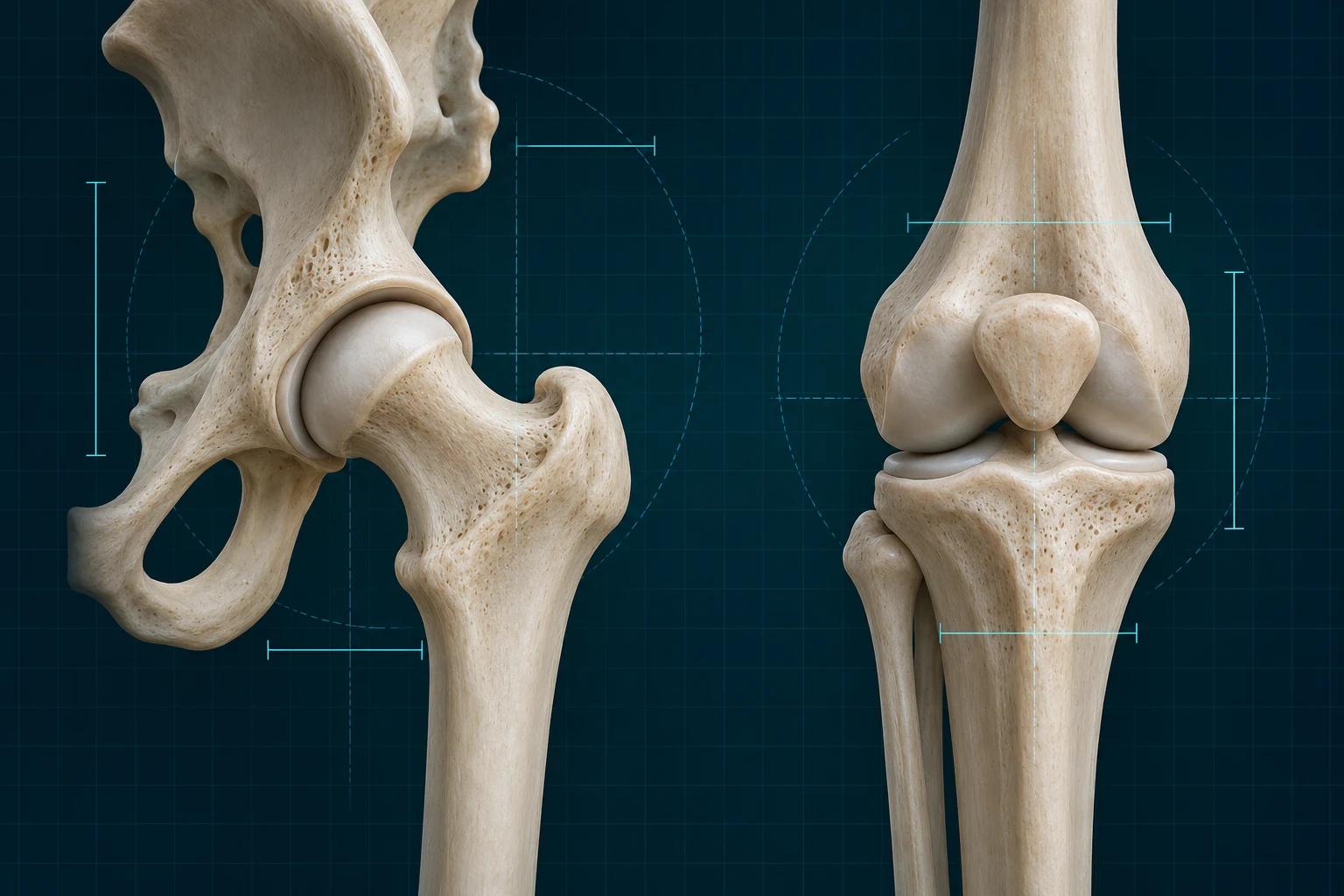 Conceptual illustration, not a patient-specific surgical plan.
02 / Beyond standard templating
Personalization means more than choosing an implant size. Each service is built around your individual anatomy, relevant imaging and your surgeon’s objectives.
Your hip is part of a moving system. SurgiPlan uses imaging to analyze spinopelvic motion—the relationship between your spine, pelvis and hip as you change position—and develops individualized implant positioning estimates, considering leg length, offset and hip mechanics. During surgery, AI-assisted tools may help your surgeon assess the reconstruction when selected as part of your clinical care.
Your elective service: individualized implant planningKinematic alignment (KA) is the anatomy-based reconstruction philosophy that informs SurgiPlan’s knee-planning approach. A customized three-dimensional model makes the geometry of your own knee tangible, supporting visualization of native joint lines, alignment and individualized reconstruction parameters for your surgeon’s independent review. Your surgeon determines the appropriate surgical technique.
Your elective service: customized 3D knee modelingThe final implant selection, alignment and surgical technique are always decisions made by your treating surgeon.
03 / Your SurgiPlan experience
A thoughtful plan should make it easier to have an informed discussion with your surgeon. Here’s how the SurgiPlan process fits into your existing care.
Your orthopedic surgeon independently determines whether hip or knee replacement and imaging are appropriate. Once you have elected surgery, you may request SurgiPlan’s optional technical planning service.
For knee replacement, relevant imaging is used to create a customized 3D model that supports anatomy-based kinematic alignment planning. For hip replacement, spinopelvic motion informs personalized implant planning. Both are developed using published research and surgeon-defined objectives.
Your surgeon independently reviews the technical planning, explains your options and makes final decisions. In hip replacement, AI-assisted intraoperative technology may support the surgeon during the procedure when selected independently as part of clinical care.
The reason behind the details
The goal of joint replacement is not just a new joint. It’s being able to do more of the things that matter to you. Thoughtful planning is one part of the process; your surgeon and care team guide your procedure and recovery.
Talk to your surgeon ↗04 / Science behind the strategy
Published orthopedic research informs our technical planning frameworks, including kinematic alignment for knees and spinopelvic assessment for hips. These studies describe surgical techniques and planning principles, not the clinical effectiveness of purchasing SurgiPlan. Your surgeon may use these techniques whether or not you participate.
Your hip, pelvis and spine work together when you sit, stand and walk. Evaluating this motion can help individualize implant positioning and identify patients at risk for instability.
A before-and-after study of 1,034 patients found significantly fewer dislocations after spinopelvic measurement was added to preoperative planning. Follow-up was at least two years; implant selection practices also changed.
Burgo et al. · Comparative study ↗In a prospective multicenter series of 2,081 patients, a hip-spine classification guided individualized component positioning and selective use of dual-mobility implants. There was no randomized comparison group.
Vigdorchik et al. · Otto Aufranc Award study ↗In 435 hip replacements, achieving spinopelvic-based cup targets was associated with modestly better postoperative Oxford Hip Scores (42 vs. 40, p = 0.003). Dislocation rates were numerically lower, but not statistically significant.
Verhaegen et al. · Prospective multicenter study ↗These studies evaluate hip-spine assessment and surgical strategies, not SurgiPlan itself. Benefits are associations observed in study populations, not guaranteed individual results. Read the background review.
Kinematic alignment (KA) aims to restore your individual knee anatomy rather than target the conventional neutral mechanical alignment (MA) axis.
A meta-analysis found modest improvements with KA in knee bending, function, satisfaction, joint awareness and pain at rest, with no significant difference in complications.
Boutros et al. · Meta-analysis ↗Across 1,068 knee replacements in seven comparative studies (five randomized trials), unrestricted KA required fewer soft-tissue releases and achieved approximately 4.6° more postoperative knee flexion.
Siddiqi et al. · Meta-analysis ↗In two trials where patients received both alignment approaches, patients were more than twice as likely to prefer the KA knee. The broader review of 11 trials found no significant differences in overall patient-reported scores or reoperations.
Blackman et al. · Meta-analysis ↗These findings concern surgical alignment strategies, not SurgiPlan itself. Benefits vary, average differences in some scores are modest, and the appropriate strategy is determined by the treating surgeon. Purchasing SurgiPlan is not required to receive KA.
05 / Cost & insurance
One elective service, one clearly defined fee. Know exactly what you're paying for before you decide.
Your SurgiPlan fee
One-time, self-pay fee for either:
Why is SurgiPlan a self-pay service?
SurgiPlan is offered on a self-pay basis because it is an elective, non-diagnostic technical planning service rather than medically necessary clinical care. The $1,500 fee pays for a separate customized digital knee model or personalized hip implant-planning deliverable, distinct from the medical evaluation, routine surgical planning and treatment provided by your orthopedic surgeon.
Insurance benefits for medical care depend on your coverage. Eligibility and applicable insurance and Medicare requirements must be reviewed before enrollment and payment. The fee is not a charge for your operation, implant, KA technique or AI-assisted surgical technology.
Choosing not to purchase SurgiPlan does not affect your medical care or access to surgery. Your surgeon independently determines the appropriate surgical technique and technology, regardless of whether you participate.
06 / Your questions answered
Clear information before you make a decision.
Have another question? ↗SurgiPlan is an optional technical preoperative planning service for hip and knee replacement. For knees, the service provides customized 3D modeling to support kinematic alignment planning. For hips, it provides personalized implant planning based on spinopelvic motion. Both are informed by published evidence and the treating surgeon’s objectives. SurgiPlan does not provide medical care, diagnose conditions or recommend surgery.
Patients discussing hip or knee replacement with their orthopedic surgeon may ask about SurgiPlan after the decision to undergo surgery has been made independently of SurgiPlan. Your surgeon determines whether joint replacement is appropriate. Participation is subject to eligibility and applicable insurance requirements, including additional restrictions for federal healthcare program beneficiaries.
No. Your treating surgeon remains responsible for your evaluation, care, final surgical plan and procedure. SurgiPlan provides technical planning support for the surgeon’s independent review.
The $1,500 per-plan fee is for a separate, elective technical planning deliverable: customized 3D knee modeling or personalized hip implant planning based on spinopelvic motion. It is offered on a self-pay basis, distinct from your medical care and surgery. Eligibility and any applicable insurance requirements must be reviewed before enrollment and payment. Your surgeon provides standard surgical care and routine clinical planning whether or not you choose SurgiPlan. See cost and insurance details.
The personalized hip planning service is performed before surgery, taking into account movement between your spine and pelvis. When independently selected by your surgeon, AI-assisted technology can help assess the reconstruction during hip replacement. AI assistance is not part of the SurgiPlan fee, and purchasing SurgiPlan is not required for your surgeon to use it. AI does not perform surgery or replace the treating surgeon’s judgment.
No. Planning can provide greater clarity about anatomical and technical factors, but surgical outcomes and recovery vary by individual. Joint replacement carries risks, including infection, blood clots, dislocation (hip), stiffness and possible further surgery. Discuss risks, benefits and alternatives with your treating surgeon.
Do not send medical records or imaging by ordinary email. If you and your surgeon decide to proceed, the necessary technical planning inputs must be provided through SurgiPlan’s approved secure process.
07 / Get started
Whether you’re considering joint replacement or you’re a surgeon interested in the SurgiPlan planning framework, we’d be happy to hear from you.
Ask your treating surgeon about personalized planning or contact us for general information.
Ask about SurgiPlan ↗Learn about incorporating evidence-informed technical planning into your practice.
Explore participation ↗General inquiries: info@mysurgiplan.com
Do not include patient names, medical details or imaging in email inquiries.